Wednesday, February 22, 2012

Ash Wednesday


Book of Joel 2:12-18.


Even now, says the LORD, return to me with your whole heart, with fasting, and weeping, and mourning; rend your hearts, not your garments, and return to the LORD, your God. For gracious and merciful is he, slow to anger, rich in kindness, and relenting in punishment. Perhaps he will again relent and leave behind him a blessing, Offerings and libations for the LORD, your God.


Blow the trumpet in Zion! proclaim a fast, call an assembly; gather the people, notify the congregation; assemble the elders, gather the children and the infants at the breast; let the bridegroom quit his room, and the bride her chamber.


Between the porch and the altar let the priests, the ministers of the LORD, weep, and say, "Spare, O LORD, your people, and make not your heritage a reproach, with the nations ruling over them! Why should they say among the peoples, 'Where is their God?'" Then the LORD was stirred to concern for his land and took pity on his people.


Psalms 51(50):3-4.5-6a.12-13.14.17.


Have mercy on me, God, in your goodness;

in your abundant compassion blot out my offense.
Wash away all my guilt; from my sin cleanse me.
For I know my offense; my sin is always before me.


Against you alone have I sinned;

I have done such evil in your sight

that you are just in your sentence,

blameless when you condemn.


A clean heart create for me, God;

renew in me a steadfast spirit.
Do not drive me from your presence,

nor take from me your holy spirit.
Restore my joy in your salvation;

sustain in me a willing spirit.
Lord, open my lips;

my mouth will proclaim your praise.


Second Letter to the Corinthians 5:20-21.6:1-2.


Brothers and sisters: We are ambassadors for Christ, as if God were appealing through us. We implore you on behalf of Christ, be reconciled to God. For our sake he made him to be sin who did not know sin, so that we might become the righteousness of God in him.


Working together, then, we appeal to you not to receive the grace of God in vain. For he says: "In an acceptable time I heard you, and on the day of salvation I helped you." Behold, now is a very acceptable time; behold, now is the day of salvation.


Holy Gospel of Jesus Christ according to Saint Matthew 6:1-6.16-18.


Jesus said to his disciples: «Take care not to perform righteous deeds in order that people may see them; otherwise, you will have no recompense from your heavenly Father. When you give alms, do not blow a trumpet before you, as the hypocrites do in the synagogues and in the streets to win the praise of others. Amen, I say to you, they have received their reward. But when you give alms, do not let your left hand know what your right is doing, so that your almsgiving may be secret. And your Father who sees in secret will repay you.


When you pray, do not be like the hypocrites, who love to stand and pray in the synagogues and on street corners so that others may see them. Amen, I say to you, they have received their reward. But when you pray, go to your inner room, close the door, and pray to your Father in secret. And your Father who sees in secret will repay you.


When you fast, do not look gloomy like the hypocrites. They neglect their appearance, so that they may appear to others to be fasting. Amen, I say to you, they have received their reward.But when you fast, anoint your head and wash your face, so that you may not appear to be fasting, except to your Father who is hidden. And your Father who sees what is hidden will repay you.

Monday, February 20, 2012

Catholic Church only exists to unite God and man, Pope teaches

Vatican City, Feb 19, 2012 / 01:26 pm (CNA/EWTN News).- In the presence of 22 cardinals who were elevated yesterday, Pope Benedict XVI said that the Catholic Church only exists for the purpose of bringing people to Jesus and not for her own sake.

“The Church does not exist for her own sake, she is not the point of arrival, but she has to point upwards, beyond herself, to the realms above,” he said Feb. 19 to a packed St. Peter’s Basilica.

“The Church is truly herself to the extent that she allows the Other, with a capital ‘O,’ to shine through her – the One from whom she comes and to whom she leads.”

The Pope made his remarks in his homily for the Mass of the Solemnity of the Chair of St. Peter.

Dwelling upon the Gospel passage in which Peter proclaims Jesus to be “the Christ, the Son of the living God,” the Pope explored the significance of Christ’s response that Peter would be “the rock” upon which the Church was built.

The Pope explained how the old covenant between God and the Jewish people was first made with Abraham, of whom the Prophet Isaiah writes, “look to the rock from which you were hewn ... look to Abraham your father.”

Therefore, just as Abraham “the father of believers” is seen as “the rock that supports creation,” so too is Peter the basis for a new covenant. He is “the rock that is to prevail against the destructive forces of evil.”

The Pope then turned his gaze towards Bernini’s 17th-century bronze sculpture, the Chair of Peter, which dominates the apse of St. Peter’s Basilica.

He described it as an “enormous bronze throne that seems to hover in mid air, but in reality is supported by the four statues of the great Fathers of the Church from East and West.” Above it, he noted, are “triumphant angles suspended in the air” and the “glory of the Holy Spirit” depicted in the oval window above. Given today’s feast, the sculpture was adorned with 144 burning candles.

Pope Benedict proposed that the statue “represents a vision of the essence of the Church and the place within the Church of the Petrine Magisterium.”

The Church “is like a window, the place where God draws near to us, where he comes towards our world,” where God “reaches” us and where we “set off” towards him, the Pope explained.

The Church “has the task of opening up, beyond itself, a world which tends to become enclosed within itself, the task of bringing to the world the light that comes from above, without which it would be uninhabitable.”

Inside the magnificent bronze throne is a wooden chair which was thought for many centuries to have belonged to St. Peter himself but was later discovered to be a 9th century gift to the Pope from the Holy Roman Emperor, Charles the Bald.

“Saint Peter’s chair, we could say, is the throne of truth which takes its origin from Christ’s commission after the confession at Caesarea Philippi,” said Pope Benedict.

He also described it as a visible reminder of the famous expression of the early Church Father, Saint Ignatius of Antioch, who described the Church of Rome as “she that ‘presides in charity’.”

“In truth, presiding in faith is inseparably linked to presiding in love. Faith without love would no longer be an authentic Christian faith,” he said.

To “preside in charity,” the Pope taught, “is to draw men and women into a Eucharistic embrace – the embrace of Christ – which surpasses every barrier and every division, creating communion from all manner of differences.”

Pope Benedict also reflected on the importance of Sacred Tradition and Sacred Scripture for the Petrine ministry. It is Sacred Scripture, interpreted with the authority of the Catholic Church and “in the light” of the Church Fathers, which sheds “light upon the Church’s journey through time, providing her with a stable foundation amid the vicissitudes of history,” he said.

Therefore, he concluded, by considering the Altar of the Chair “in its entirety” we can see “twofold movement” of “ascending and descending” which depicts “the reciprocity between faith and love.”

“Whoever believes in Jesus Christ and enters into the dynamic of love that finds its source in the Eucharist,” he stated, “discovers true joy and becomes capable in turn of living according to the logic of this gift.”

“True faith is illumined by love and leads towards love,” just as “the altar of the Chair points upwards towards the luminous window, the glory of the Holy Spirit, which constitutes the true focus for the pilgrim’s gaze as he crosses the threshold of the Vatican Basilica.”

Pope Benedict later returned to similar reflections after Mass as he addressed pilgrims in St. Peter’s Square for the Sunday Angelus address, which he delivered from the window of his apartment.

“The Chair of St. Peter,” he told them, “is a symbol of the special mission of Peter and his successors to shepherd the flock of Christ, holding it together in faith and charity.”

Before praying the midday Marian prayer, he entrusted the new cardinals “to the maternal protection of Mary Most Holy, asking that she always assist them in their service to the Church and sustain them in any trials they may face.”

Sunday, February 19, 2012

The New Cardinals

This weekend is special as 22 new Cardinals are created. Among them is Thomas Collins from here in Toronto so excuse me for a little Canadian pride on that. I have seen Cardinal Collins many times on television and really like him and have seen a lot of the work he has done since he became the Arch Bishop of the Toronto diocese. I have seen his LectioDivina series on Salt and Light television many times and just loved the way he interacted and left you with a feeling of wanting to pick up the bible to learn more of God's word.

The other Cardinal who caught my eye is Timothy Dolan from the United States. I have seen him many times on EWTN with my favourite father, Father Benedict, and my only wish was I lived in New York and could be a parishioner at Caridinal Dolan's church. Wow what a personality and what a truly wonderful god loving man. He is kind of the opposite of Cardinal Collins who is a bit less charismatic or actually wrong word but just quieter in personality.

I love Dolan's smarts and how truthfully his opinions about the current US administration is. He just seems so magnetic well at least to me. Could he be pope one day? Possibility is there, would he be good for the position? I think so he certainly would put the Vatican on the front page but I also think he would do a lot of good for the catholic church and faith as he deeply loves the church and god and this as from cardinal Collins radiates from him.

Here is his address to the College of Cardinals in Rome sit back and enjoy and may God Bless these new Cardinals to help the Catholic Church and guide her and us to the glory our lord has promised:

The Announcement of the Gospel Today, Between missio ad gentes and the New Evangelization

Holy Father, Cardinal Sodano, my brothers in Christ:
Sia lodato Gesu Cristo!

It is as old as the final mandate of Jesus, “Go, teach all nations!,” yet as fresh as God’s Holy Word proclaimed at our own Mass this morning.

I speak of the sacred duty of evangelization. It is “ever ancient, ever new.” The how of it, the when of it, the where of it, may change, but the charge remains constant, as does the message and inspiration, “Jesus Christ, the same yesterday, today, and tomorrow.”

We gather in the caput mundi, evangelized by Peter and Paul themselves, in the city from where the successors of St. Peter “sent out” evangelizers to present the saving Person, message, and invitation that is at the heart of evangelization: throughout Europe, to the “new world” in the “era of discovery,” to Africa and Asia in recent centuries.

We gather near the basilica where the evangelical fervor of the Church was expanded during the Second Vatican Council, and near the tomb of the Blessed Pontiff who made the New Evangelization a household word.

We gather grateful for the fraternal company of a pastor who has made the challenge of the new evangelization almost a daily message.

Yes, we gather as missionaries, as evangelizers.

We hail the teaching of the Second Vatican Council, especially found in Lumen Gentium, Gaudium et Spes, and Ad Gentes, that refines the Church’s understanding of her evangelical duty, defining the entire Church as missionary, that all Christians, by reason of baptism, confirmation, and Eucharist, are evangelizers.

Yes, the Council reaffirmed, especially in Ad Gentes, there are explicit missionaries, sent to lands and peoples who have never heard the very Name by which all are saved, but also that no Christian is exempt from the duty of witnessing to Jesus and offering His invitation to others in his own day-to-day life.

Thus, mission became central to the life of every local church, to every believer. The context of mission shifted not only in a geographical sense, but in a theological sense, as mission applied not only to unbelievers but to believers, and some thoughtful people began to wonder if such a providential expansion of the concept of evangelization unintentionally diluted the emphasis of mission ad gentes.

Blessed John Paul II developed this fresh understanding, speaking of evangelizing cultures, since the engagement between faith and culture supplanted the relationship between church and state dominant prior to the Council, and included in this task the re-evangelizing of cultures that had once been the very engine of gospel values. The New Evangelization became the dare to apply the invitation of Jesus to conversion of heart not only ad extra but ad intra, to believers and cultures where the salt of the gospel had lost its tang. Thus, the missio is not only to New Guinea but to New York.

In Redemptoris Missio, #33, he elaborated upon this, noting primary evangelization — the preaching of Jesus to lands and people unaware of His saving message — the New Evangelization — the rekindling of faith in persons and cultures where it has grown lackluster — and the pastoral care of those daily living as believers.

We of course acknowledge that there can be no opposition between the missio ad gentes and the New Evangelization. It is not an “either-or” but a “both-and” proposition. The New Evangelization generates enthusiastic missionaries; those in the apostolate of the missio ad gentes require themselves to be constantly evangelized anew.

Even in the New Testament, to the very generation who had the missio ad gentes given by the Master at His ascension still ringing in their ears, Paul had to remind them to “stir into flame” the gift of faith given them, certainly an early instance of the New Evangelization.

And, just recently, in the inspirational Synod in Africa, we heard our brothers from the very lands radiant with the fruits of the missio ad gentes report that those now in the second and third generation after the initial missionary zeal already stand in need of the New Evangelization.

The acclaimed American missionary and TV evangelist, Archbishop Fulton J. Sheen, commented, “Our Lord’s first word to His disciples was ‘come!’ His last word was ‘go!’ You can’t ‘go’ unless you’ve first ‘come’ to Him.”

A towering challenge to both the missio ad gentes and the New Evangalization today is what we call secularism. Listen to how our Pope describes it:

Secularization, which presents itself in cultures by imposing a world and
humanity without reference to Transcendence, is invading every aspect of daily life and developing a mentality in which God is effectively absent, wholly or partially, from human life and awareness. This secularization is not only an external threat to believers, but has been manifest for some time in the heart of the Church herself. It profoundly distorts the Christian faith from within, and consequently, the lifestyle and daily behavior of believers. They live in the world and are often marked, if not conditioned, by the cultural imagery that impresses contradictory and impelling models regarding the practical denial of God: there is no longer any need for God, to think of him or to return to him. Furthermore, the prevalent hedonistic and consumeristic mindset fosters in the faithful and in Pastors a tendency to superficiality and selfishness that is harmful to ecclesial life. (Benedict XVI, Address to Pontifical Council for Culture, 8.III.2008)

This secularization calls for a creative strategy of evangelization, and I want to detail seven planks of this strategy.

1. Actually, in graciously inviting me to speak on this topic, “The Announcement of the Gospel Today, between missio ad gentes and the new evangelization,” my new-brother-cardinal, His Eminence, the Secretary of State, asked me to put in into the context of secularism, hinting that my home archdiocese of New York might be the “capital of a secular culture.”

As I trust my friend and new-brother-cardinal, Edwin O’Brien — who grew up in New York — will agree, New York — without denying its dramatic evidence of graphic secularism — is also a very religious city.

There one finds, even among groups usually identified as materialistic — the media, entertainment, business, politics, artists, writers — an undeniable openness to the divine!

The cardinals who serve Jesus and His Church universal on the Roman Curia may recall the address Pope Benedict gave them at Christmas two years ago when he celebrated this innate openness to the divine obvious even in those who boast of their secularism:

We as believers, must have at heart even those people who consider themselves agnostics or atheists. When we speak of a new evangelization these people are perhaps taken aback. They do not want to see themselves as an object of mission or to give up their freedom of thought and will. Yet the question of God remains present even for them. As the first step of evangelization we must seek to keep this quest alive; we must be concerned that human beings do not set aside the question of God, but rather see it as an essential question for their lives. We must make sure that they are open to this question and to the yearning concealed within. I think that today too the Church should open a sort of “Court of the Gentiles” in which people might in some way latch on to God, without knowing him and before gaining access to his mystery, at whose service the inner life of the Church stands.

This is my first point: we believe with the philosophers and poets of old, who never had the benefit of revelation, that even a person who brags about being secular and is dismissive of religion, has within an undeniable spark of interest in the beyond, and recognizes that humanity and creation is a dismal riddle without the concept of some kind of creator.

A movie popular at home now is The Way, starring a popular actor, Martin Sheen. Perhaps you have seen it. He plays a grieving father whose estranged son dies while walking the Camino di Santiago di Campostella in Spain. The father decides, in his grief, to complete the pilgrimage in place of his dead son. He is an icon of a secular man: self-satisfied, dismissive of God and religion, calling himself a “former Catholic,” cynical about faith . . . but yet unable to deny within him an irrepressible interest in the transcendent, a thirst for something — no, Someone — more, which grows on the way.

Yes, to borrow the report of the apostles to Jesus from last Sunday’s gospel, “All the people are looking for you!”

They still are . . .

2. . . . and, my second point, this fact gives us immense confidence and courage in the sacred task of mission and New Evangelization.

“Be not afraid,” we’re told, is the most repeated exhortation in the Bible.

After the Council, the good news was that triumphalism in the Church was dead.

The bad news was that, so was confidence!

We are convinced, confident, and courageous in the New Evangelization because of the power of the Person sending us on mission — who happens to be the second Person of the Most Blessed Trinity – because of the truth of the message, and the deep down openness in even the most secularized of people to the divine.

Confident, yes!

Triumphant, never!

What keeps us from the swagger and arrogance of triumphalism is a recognition of what Pope Paul VI taught in Evangelii Nuntiandi: the Church herself needs evangelization!

This gives us humility as we confess that Nemo dat quod not habet, that the Church has a deep need for the interior conversion that is at the marrow of the call to evangelization.

3. A third necessary ingredient in the recipe of effective mission is that God does not satisfy the thirst of the human heart with a proposition, but with a Person, whose name is Jesus.

The invitation implicit in the Missio ad gentes and the New Evangelization is not to a doctrine but to know, love, and serve — not a something, but a Someone.

When you began your ministry as successor of St. Peter, Holy Father, you invited us to friendship with Jesus, which is the way you defined sanctity.

There it is . . . love of a Person, a relationship at the root of out faith.

As St. Augustine writes, “Ex una sane doctrina impressam fidem credentium cordibus singulorum qui hoc idem credunt verissime dicimus, sed aliud sunt ea quae creduntur, aliud fides qua creduntur” (De Trinitate, XIII, 2.5)

4. Yes, and here’s my fourth point, but this Person, Jesus, tells us He is the truth.

So, our mission has a substance, a content, and this twentieth anniversary of the Catechism, the approaching fiftieth anniversary of the Council, and the upcoming Year of Faith charge us to combat catechetical illiteracy.

True enough, the New Evangalization is urgent because secularism has often choked the seed of faith; but that choking was sadly made easy because so many believers really had no adequate knowledge or grasp of the wisdom, beauty, and coherence of the Truth.

Cardinal George Pell has observed that “it’s not so much that our people have lost their faith, but that they barely had it to begin with; and, if they did, it was so vapid that it was easily taken away.”

So did Cardinal Avery Dulles call for neo-apologetics, rooted not in dull polemics but in the Truth that has a name, Jesus.

So did Blessed John Newman, upon reception of his own biglietto nominating him a cardinal warn again of what he constantly called a dangerous liberalism in religion: “. . . the belief that there is no objective truth in religion, that one creed is as good as another . . . Revealed religion is not a truth, but a sentiment, a taste . . . ”

And, just as Jesus tells us “I am the Truth,” He also describes Himself as “the Way, and the Life.”

The Way of Jesus is in and through His Church, a holy mother who imparts to us His Life.

“For what would I ever know of Him without her?” asks De Lubac, referring to the intimate identification of Jesus and His Church.

Thus, our mission, the New Evangelization, has essential catechetical and ecclesial dimensions.

This impels us to think about Church in a fresh way: to think of the Church as a mission. As John Paul II taught in Redemptoris Missio, the Church does not “have a mission,” as if “mission” were one of many things the Church does. No, the Church is a mission, and each of us who names Jesus as Lord and Savior should measure ourselves by our mission-effectiveness.

Over the fifty years since the convocation of the Council, we have seen the Church pass through the last stages of the Counter-Reformation and rediscover itself as a missionary enterprise. In some venues, this has meant a new discovery of the Gospel. In once-catechized lands, it has meant a re-evangelization that sets out from the shallow waters of institutional maintenance, and as John Paul II instructed us in Novo Millennio Ineunte, puts out “into the deep” for a catch.

In many of the countries represented in this college, the ambient public culture once transmitted the Gospel, but does so no more. In those circumstances, the proclamation of the Gospel — the deliberate invitation to enter into friendship with the Lord Jesus — must be at the very center of the Catholic life of all of our people. But in all circumstances, the Second Vatican Council and the two great popes who have given it an authoritative interpretation are urging us to call our people to think of themselves as missionaries and evangelists.

5. When I was a new seminarian at the North American College here in Rome, all the first-year men from all the Roman theological universities were invited to a Mass at St. Peter’s with the Prefect of the Congregation for the Clergy, Cardinal John Wright, as celebrant and homilist.

We thought he would give us a cerebral homily. But he began by asking, “Seminarians: do me and the Church a big favor. When you walk the streets of Rome, smile!”

So, point five: the missionary, the evangelist, must be a person of joy.

“Joy is the infallible sign of God’s presence,” claims Leon Bloy.

When I became Archbishop of New York, a priest old me, “You better stop smiling when you walk the streets of Manhattan, or you’ll be arrested!”

A man dying of AIDS at the Gift of Peace Hospice, administered by the Missionaries of Charity in Cardinal Donald Wuerl’s Archdiocese of Washington, asked for baptism. When the priest asked for an expression of faith, the dying man whispered, “All I know is that I’m unhappy, and these sisters are very happy, even when I curse them and spit on them. Yesterday I finally asked them why they were so happy. They replied ‘Jesus.’ I want this Jesus so I can finally be happy.

A genuine act of faith, right?

The New Evangelization is accomplished with a smile, not a frown.

The missio ad gentes is all about a yes to everything decent, good, true, beautiful and noble in the human person.

The Church is about a yes!, not a no!

6. And, next-to-last point, the New Evangelization is about love.

Recently, our brother John Thomas Kattrukudiyil, the Bishop of Itanagar, in the northeast corner of India, was asked to explain the tremendous growth of the Church in his diocese, registering over 10,000 adult converts a year.

“Because we present God as a loving father, and because people see the Church loving them.” he replied.

Not a nebulous love, he went on, but a love incarnate in wonderful schools for all children, clinics for the sick, homes for the elderly, centers for orphans, food for the hungry.

In New York, the heart of the most hardened secularist softens when visiting one of our inner-city Catholic schools. When one of our benefactors, who described himself as an agnostic, asked Sister Michelle why, at her age, with painful arthritic knees, she continued to serve at one of these struggling but excellent poor schools, she answered, “Because God loves me, and I love Him, and I want these children to discover this love.”

7. Joy, love . . . and, last point . . . sorry to bring it up, . . . but blood.

Tomorrow, twenty-two of us will hear what most of you have heard before:

“To the praise of God, and the honor of the Apostolic See
receive the red biretta, the sign of the cardinal’s dignity;
and know that you must be willing to conduct yourselves with fortitude
even to the shedding of your blood:
for the growth of the Christian faith,
the peace and tranquility of the People of God,
and the freedom and spread of the Holy Roman Church.”

Holy Father,can you omit “to the shedding of your blood” when you present me with the biretta?

Of course not! We are but “scarlet audio-visual aids” for all of our brothers and sisters also called to be ready to suffer and die for Jesus.

It was Pope Paul VI who noted wisely that people today learn more from “witness than from words,” and the supreme witness is martyrdom.

Sadly, today we have martyrs in abundance.

Thank you, Holy Father, for so often reminding us of those today suffering persecution for their faith throughout the world.

Thank you, Cardinal Koch, for calling the Church to an annual “day of solidarity” with those persecuted for the sake of the gospel, and for inviting our ecumenical and inter-religious partners to an “ecumenism of martyrdom.”

While we cry for today’s martyrs; while we love them, pray with and for them; while we vigorously advocate on their behalf; we are also very proud of them, brag about them, and trumpet their supreme witness to the world.

They spark the missio ad gentes and New Evangelization.

A young man in New York tells me he returned to the Catholic faith of his childhood, which he had jettisoned as a teenager, because he read The Monks of Tibhirine, about Trappists martyred in Algeria fifteen years ago, and after viewing the drama about them, the French film, Of Gods and Men.

Tertullian would not be surprised.

Thank you, Holy Father and brethren, for your patience with my primitive Italian. When Cardinal Bertone asked me to give this address in Italian, I worried, because I speak Italian like a child.

But, then I recalled, that, as a newly-ordained parish priest, my first pastor said to me as I went over to school to teach the six-year old children their catechism, “Now we’ll see if all your theology sunk in, and if you can speak of the faith like a child.”

And maybe that’s a fitting place to conclude: we need to speak again as a child the eternal truth, beauty, and simplicity of Jesus and His Church.

Sia lodato Gesu Cristo!

Seventh Sunday in Ordinary Time


Book of Isaiah 43:18-19.21-22.24b-25.


Remember not the events of the past, the things of long ago consider not; see, I am doing something new! Now it springs forth, do you not perceive it? In the desert I make a way, in the wasteland, rivers.
The people whom I formed for myself, that they might announce my praise. Yet you did not call upon me, O Jacob, for you grew weary of me, O Israel. You did not buy me sweet cane for money, nor fill me with the fat of your sacrifices; Instead, you burdened me with your sins, and wearied me with your crimes. It is I, I, who wipe out, for my own sake, your offenses; your sins I remember no more.


Psalms 41(40):2-3.4-5.13-14.


Happy those concerned for the lowly and poor;

when misfortune strikes, the LORD delivers them.

The LORD keeps and preserves them,

makes them happy in the land,

and does not betray them to their enemies.


The LORD sustains them on their sickbed,

allays the malady when they are ill.
Once I prayed, "LORD, have mercy on me;

heal me, I have sinned against you.

For my integrity you have supported me

and let me stand in your presence forever.
Blessed be the LORD, the God of Israel,

from all eternity and forever. Amen. Amen.


Second Letter to the Corinthians 1:18-22.


As God is faithful, our word to you is not "yes" and "no." For the Son of God, Jesus Christ, who was proclaimed to you by us, Silvanus and Timothy and me, was not "yes" and "no," but "yes" has been in him. For however many are the promises of God, their Yes is in him; therefore, the Amen from us also goes through him to God for glory.
But the one who gives us security with you in Christ and who anointed us is God; he has also put his seal upon us and given the Spirit in our hearts as a first installment.


Holy Gospel of Jesus Christ according to Saint Mark 2:1-12.


When Jesus returned to Capernaum after some days, it became known that he was at home. Many gathered together so that there was no longer room for them, not even around the door, and he preached the word to them.
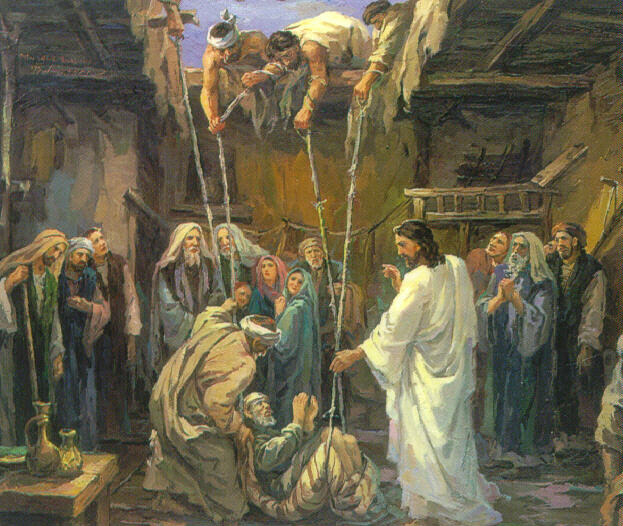
They came bringing to him a paralytic carried by four men. Unable to get near Jesus because of the crowd, they opened up the roof above him. After they had broken through, they let down the mat on which the paralytic was lying.
When Jesus saw their faith, he said to the paralytic, "Child, your sins are forgiven." Now some of the scribes were sitting there asking themselves, Why does this man speak that way? He is blaspheming. Who but God alone can forgive sins? Jesus immediately knew in his mind what they were thinking to themselves, so he said, "Why are you thinking such things in your hearts? Which is easier, to say to the paralytic, 'Your sins are forgiven,' or to say, 'Rise, pick up your mat and walk'? But that you may know that the Son of Man has authority to forgive sins on earth"- he said to the paralytic, "I say to you, rise, pick up your mat, and go home."
He rose, picked up his mat at once, and went away in the sight of everyone. They were all astounded and glorified God, saying, "We have never seen anything like this."

Saturday, February 18, 2012

Jesus’ prayers on cross should inspire forgiveness, Pope teaches

Vatican City, Feb 15, 2012 / 11:38 am (CNA/EWTN News).- The final words of Jesus Christ as he died on the cross should prompt Christians to pray for those who have hurt them, Pope Benedict XVI said on Feb. 15.

“Jesus by asking the Father to forgive those who are crucifying him, invites us to the difficult act of praying for those who do us wrong, who have damaged us, knowing always how to forgive,” the Pope told over 6,000 pilgrims attending today’s general audience in Paul VI Hall.

The Pope urged people to pray that “the light of God may illuminate their hearts, inviting us, that is, to live in our prayers, the same attitude of mercy and love that God has towards us.”

This attitude, he explained, is summed up in one line from the Our Father – “forgive us our trespasses as we forgive those who trespass against us.”

Over the past several months, the Pope has used his weekly general audiences to explore the issue of prayer. This week he focused on the three last prayers of Jesus from the cross.

The first prayer was pronounced by Jesus immediately after he was nailed to the cross, “while the soldiers are dividing his garments as sad reward of their service.” The prayer Christ uttered was: “Father, forgive them, they know not what they do.”

In his prayer of intercession, Jesus “asks forgiveness for his executioners,” and in doing so, “carries out what he had taught in the Sermon on the Mount” when he urged his followers to “love your enemy,” “do good to those who hate you,” and promised to reward those who forgive.

Crucially, said the Pope, Jesus gives “ignorance, ‘not knowing,’ as the reason for the request for forgiveness from the Father.” This should give “consolation for all times and for all men” because Jesus sees ignorance “as a door that can open us up to repentance.”

The second prayer of Christ is directed towards the good thief who repents after sensing he is “before the Son of God, who reveals the face of God.” Once he recognized this, the thief prayed, “Jesus, remember me when you come into your kingdom.”

Jesus answered him: “Amen, I say to you, today you will be with me in Paradise.” In doing so, Christ is “aware of entering directly into communion with the Father” and of “reopening the path for the man to God’s paradise.”

This should give all people hope, said Pope Benedict,since it shows that “the goodness of God can touch us even at the last moment of life.” And that “sincere prayer, even after a life of wrong, meets the open arms of the good Father who awaits the return of his son.”

The Pope then turned to Christ’s final prayer on the cross – “Father, into your hands I commend my spirit.” He noted how each of the Gospel writers describes different aspects of this moment in history, including the veil of the temple being torn down the middle, three hours of darkness over the land and earthquakes.

“The death of Jesus is explicitly characterized as a cosmic and liturgical event,” said the Pope, “it marks the beginning of a new worship in a temple not built by men.”

The prayer is also a “loud cry of extreme and total trust in God,” fully aware of “not being abandoned.” This is signified by the use of the word “Father,” which recalls Christ’s first declaration that he is the son of God when he was a 12-year-old boy and was found in the temple by his parents.

“Then he remained for three days in the temple of Jerusalem, the veil of which is now torn,” and so we see that “from beginning to end, what completely determines the feelings of Jesus, his words, his actions is his unique relationship with the Father.”

All in all, concluded the Pope, the three final prayers of Jesus are “tragic” for every man but are also “pervaded by the deep calm that comes from trust in the Father and the will to abandon himself totally to him.” They are a “supreme act of love” which went “to the limit and beyond the limit.”

As well as prompting us to pray for our enemies, the final prayers of Jesus should also teach Christians that “no matter how hard the trial, difficult the problem, heavy the suffering, we never fall from the hands of God,” Pope Benedict said.

A Prayer for Today

Helper of those who turn to you,
light of those in the dark,
creator of all that grows from seed,
promoter of all spiritual growth,
have mercy, Lord, on me
and make me a temple fit for yourself.
Do not scan my transgressions too closely,
for if you are quick to notice my offenses,
I shall not dare to appear before you.
In your great mercy,
in your boundless compassion,
wash away my sins, through Jesus Christ,
your only child, the truly holy,
the chief of our souls' healers.
Through him may all glory be given you,
all power and honor and praise,
throughout the unending succession of ages. Amen.
- An early Christian prayer

Monday, February 13, 2012

The Pope's Take on Things

So as you saw in yesterday's readings Jesus cures the leper. Certainly a large step and gesture by Jesus considering the implications of dealing with a leper. Here is the Holy Father's explanation for you also,

Jesus cured leper to show man’s salvation, Pope says

Vatican City, Feb 12, 2012 / 02:26 pm (CNA/EWTN News).- Jesus Christ’s healing of the leper in the Gospel of Mark encapsulates the whole history of salvation, said Pope Benedict XVI in his Sunday Angelus address for Feb. 12.

When Jesus met the leper, he came into contact with a form of illness “considered at that time the most serious, enough to render a person ‘impure’ and to exclude them from the society,” the Pope explained to pilgrims in St. Peter’s Square.

There was even special legislation that reserved to Jewish priests “the task of declaring the person leprous, that is impure,” he said. It was the job of the Jewish priests to decide if and when to re-admit the sufferer to society after they had been deemed cured.

It was in this context that a leper came to Jesus beseeching him and telling him “‘If you will, you can make me clean,'” according Mark’s account of the event.

Contrary to the legal bans, noted the Pope, “Jesus does not avoid contact with this man, indeed, he is driven to an intimate participation in his condition, stretches out his hand and touches it.” He responds to the man’s plea by telling him “I will it, be cleansed.”

“In that gesture and those words of Christ is the whole history of salvation,” stated the Pope, “there is embodied the will of God to heal us, to cleanse us from evil that disfigures and that disrupts our relationships.”

This contact between the hand of Jesus and the leper “knocks down every barrier between God and human impurities, between the Sacred and its opposite.” The actions of Jesus do not deny the reality of “evil and its negative force,” but shows that “the love of God is stronger than any evil, even of the most contagious and horrible.” In doing so, “Jesus took upon himself our infirmities, became the ‘leper’ because we were purified.”

The Pope recalled the words of the 13th-century saint, Francis of Assisi, who spoke about lepers and ministered to them.

“When I lived in sin, it was very painful to me to see lepers,” wrote St. Francis, “but God himself led me into their midst, and I remained there a little while.” By the time he left, “that which had seemed to me bitter had become sweet and easy.”

The Pope said that in learning to literally embrace lepers, St. Francis had been healed of his “leprosy,” namely his pride. That breakthrough “converted him to the love of God.”

“This is the victory of Christ, which is our deep healing and our resurrection to new life!” proclaimed Pope Benedict.

Before leading pilgrims in praying the Angelus, the Pope urged those present to direct their prayers towards the Virgin Mary. He noted that yesterday marked the 154th anniversary of her first appearance in the French town of Lourdes to the local miller’s daughter, Bernadette Soubirous.

“To St. Bernadette, Our Lady gave a timeless message: the call to prayer and penance,” said the Pope.

“Through his mother it is always Jesus who comes to us, to deliver us from all sickness of body and soul. Let us allow ourselves to be touched and purified by him, and show mercy towards our brothers!”


Sunday, February 12, 2012

Sixth Sunday in Ordinary Time


Book of Leviticus 13:1-2.44-46.


The LORD said to Moses and Aaron, "If someone has on his skin a scab or pustule or blotch which appears to be the sore of leprosy, he shall be brought to Aaron, the priest, or to one of the priests among his descendants, the man is leprous and unclean, and the priest shall declare him unclean by reason of the sore on his head. The one who bears the sore of leprosy shall keep his garments rent and his head bare, and shall muffle his beard; he shall cry out, 'Unclean, unclean!' As long as the sore is on him he shall declare himself unclean, since he is in fact unclean. He shall dwell apart, making his abode outside the camp.


Psalms 32(31):1-2.5.11.


Of David. A maskil.

Happy the sinner whose fault is removed,

whose sin is forgiven.

Happy those to whom the LORD imputes no guilt,

in whose spirit is no deceit.


Then I declared my sin to you;

my guilt I did not hide.

I said, "I confess my faults to the LORD,"

and you took away the guilt of my sin.

Selah Be glad in the LORD and rejoice, you just;

exult, all you upright of heart.


First Letter to the Corinthians 10:31-33.11:1.


So whether you eat or drink, or whatever you do, do everything for the glory of God. Avoid giving offense, whether to Jews or Greeks or the church of God, just as I try to please everyone in every way, not seeking my own benefit but that of the many, that they may be saved. Be imitators of me, as I am of Christ.


Holy Gospel of Jesus Christ according to Saint Mark 1:40-45.


A leper came to him and kneeling down begged him and said, "If you wish, you can make me clean." Moved with pity, he stretched out his hand, touched him, and said to him, "I do will it. Be made clean." The leprosy left him immediately, and he was made clean. Then, warning him sternly, he dismissed him at once. Then he said to him, "See that you tell no one anything, but go, show yourself to the priest and offer for your cleansing what Moses prescribed; that will be proof for them."


The man went away and began to publicize the whole matter. He spread the report abroad so that it was impossible for Jesus to enter a town openly. He remained outside in deserted places, and people kept coming to him from everywhere.

Friday, February 10, 2012

My First Friday Experience

Last week I finally attended a First Friday mass. Truly an amazing experience for the adoration of the blessed sacrament along with the benediction. For me it was powerful and brought me to a level of inner peace I have not felt for a long time.
It was truly a unique experience at this parish as the mass was said in English, Polish and for good measure some Latin. It was unique because with the different cultures and languages involved we were all one together with the Lord. Truly wonderful and I was amazed by Father A who did the mass and was magnificent and made us all appreciate being there and spending this time with God.
This weekend we have a relic from our Lady of Guadeloupe visiting the parish and some special masses including one in Spanish which I might attend also.
As you know I attend two parishes one English (which is really English and Polish) and of course my beloved Hungarian parish.
We have been fortunate enough to lately have helped a lot at the Hungarian parish. It seems the war clouds have settled and Father has cleaned house so to speak and we have become a part of his team in helping in and around the parish where we help because we want to and it is in our heart and not help because we are looking for stature or monetary reward. This was Father's war with the old guard who thought the parish existed because of them instead of appreciating the fact that the parish existed for them, to pray and be close to God. Yes there has been like in any war casualties as the numbers on Sunday have dipped but we truly believe when people see the church is there for spiritual gain and not financial and personal gain many will start to wander back in. Until then I pray that the parish stays strong to move forward. For you all God Bless and take care!

A Prayer for Today

Jesus, you promised that
whatever was done for the least
was done for you.
Give us the grace
to be always ready
to serve the needs of others,
and to extend the blessings
of your kingdom
over all the world,
to your praise and glory. Amen.
- St. Augustine of Hippo

Thursday, February 9, 2012

A Prayer for Today

Jesus, you promised that
whatever was done for the least
was done for you.
Give us the grace
to be always ready
to serve the needs of others,
and to extend the blessings
of your kingdom
over all the world,
to your praise and glory. Amen.
- St. Augustine of Hippo

Sunday, February 5, 2012

Fifth Sunday in Ordinary Time


Job 7: 1 - 4, 6 - 7
1 "Has not man a hard service upon earth, and are not his days like the days of a hireling?
2 Like a slave who longs for the shadow, and like a hireling who looks for his wages,
3 so I am allotted months of emptiness, and nights of misery are apportioned to me.
4 When I lie down I say, `When shall I arise?' But the night is long, and I am full of tossing till the dawn.
6 My days are swifter than a weaver's shuttle, and come to their end without hope.
7 "Remember that my life is a breath; my eye will never again see good.

Psalms 147: 1 - 6
1 Praise the LORD! For it is good to sing praises to our God; for he is gracious, and a song of praise is seemly.
2 The LORD builds up Jerusalem; he gathers the outcasts of Israel.
3 He heals the brokenhearted, and binds up their wounds.
4 He determines the number of the stars, he gives to all of them their names.
5 Great is our LORD, and abundant in power; his understanding is beyond measure.
6 The LORD lifts up the downtrodden, he casts the wicked to the ground.

1 Corinthians 9: 16 - 19, 22 - 23
16 For if I preach the gospel, that gives me no ground for boasting. For necessity is laid upon me. Woe to me if I do not preach the gospel!
17 For if I do this of my own will, I have a reward; but if not of my own will, I am entrusted with a commission.
18 What then is my reward? Just this: that in my preaching I may make the gospel free of charge, not making full use of my right in the gospel.
19 For though I am free from all men, I have made myself a slave to all, that I might win the more.
22 To the weak I became weak, that I might win the weak. I have become all things to all men, that I might by all means save some.
23 I do it all for the sake of the gospel, that I may share in its blessings.

Mark 1: 29 - 39
29 And immediately he left the synagogue, and entered the house of Simon and Andrew, with James and John.
30 Now Simon's mother-in-law lay sick with a fever, and immediately they told him of her.
31 And he came and took her by the hand and lifted her up, and the fever left her; and she served them.
32 That evening, at sundown, they brought to him all who were sick or possessed with demons.
33 And the whole city was gathered together about the door.
34 And he healed many who were sick with various diseases, and cast out many demons; and he would not permit the demons to speak, because they knew him.
35 And in the morning, a great while before day, he rose and went out to a lonely place, and there he prayed.
36 And Simon and those who were with him pursued him,
37 and they found him and said to him, "Every one is searching for you."
38 And he said to them, "Let us go on to the next towns, that I may preach there also; for that is why I came out."
39 And he went throughout all Galilee, preaching in their synagogues and casting out demons.

Saturday, February 4, 2012

A Prayer For Saturday

Lord, I believe that you are present here. You know me through and through, and despite my weaknesses, sins and imperfections you love me. Lord, thank you for your love. Today I give you my mind, my heart and my will. Mold me and use me as you wish.